stock-prediction-deep-neural-learning
Predicting stock prices using a TensorFlow LSTM (long short-term memory) neural network for times series forecasting
View the Project on GitHub JordiCorbilla/stock-prediction-deep-neural-learning
How this repository powers our ICAIF trading agent
For the submitted checkpoints, final review status and exact offline replay,
see the November 1 final handoff. The default feature
calculation preserves frozen arithmetic; the vectorized research alternative
is explicitly named enhanced_features_fast and may round differently.
The competition model is built from this repository’s LongShortTermMemory
factory in stock_prediction_lstm.py. It calls
create_return_multitask_model, which constructs the v9 shared 128/64 LSTM
encoder. Training extracts the expected_return head. The direction and
quantile heads are not claimed trained in this competition experiment.
The architecture file is unchanged. Its SHA256 matches the frozen source reference for the accepted October 9 Validation ensemble. Archive checks verify the encoder widths and named return head in the historical and live models. A source-import training entrypoint and saved input/model hashes make the lineage inspectable, rather than relying on a matching model name alone.
The competition additions are maintained here
quant_forecast_lab/icaif.py: causal feature construction, 10/15/20-session lookbacks, optional observed VIX features, the portfolio tilt and the no-trade band.quant_forecast_lab/icaif_training.py: three-seed deterministic training through the existing v9 factory, purged chronological validation, stopping using earlier data, and source/input provenance.tests/test_icaif.py: future-prefix invariance, VIX alignment, allocation constraints and skipped trades.
The competition repository imports these maintained functions. Exact numeric checks confirm that moving the six-feature construction into this repository does not change any stored 2023 training/validation/inference input, and that the allocation adapter matches the established policy. The portfolio engine, organizer API reader, schedule and private credentials remain in the separate competition project.
What changed from the original price-prediction example
The network architecture remains ours. The task-specific differences are:
- Predict two-session stock returns relative to the equal-weight market, using fixed 0.02 scaling rather than a scaler fitted on all observations.
- Use six causal stock/market/trend features. Each intermediate feature uses only its own sequence prefix. Optional VIX features are observed level/40 and clipped log change/0.1, aligned to completed stock sessions.
- Fit seeds 7, 42 and 123, average their predictions, and choose checkpoints using a purged earlier validation period.
- Allocate 99% nominal equity: 80% of that equally across 30 stocks and 20% across the ten highest scores. Retain shares when proposed buying plus selling is below 12% of current NAV; pay 0.1% of each traded notional.
The original frozen LSTM and the enhanced ensemble are distinct fitted variants of the same user architecture. We do not present other authors’ MASTER architecture or a third-party pretrained checkpoint as our LSTM.
Reproduce with both source repositories
Clone the LSTM and ICAIF competition repositories as siblings, then use their
documented environments and the organizer’s dataset. The competition bridge
defaults to the sibling source directory; ICAIF_LSTM_SOURCE can specify a
different checkout. Run from the competition repository:
python verify_user_lstm_lineage.py
python continuous_lstm_replay.py
python lstm_lookback_vix_research.py
python prepare_lstm_band_preview.py
The preview requires the user’s private competition credentials and makes GET requests only. It writes a shadow review without submission credentials; it does not upload or alter holdings. Other commands use historical data. Generated data and models remain outside Git.
The training module can also be invoked from this repository:
.venv/Scripts/python.exe -m quant_forecast_lab.icaif_training --input <causal-samples.npz> --output <experiment-folder>
.venv/Scripts/python.exe -m pytest tests -q
The samples archive must provide train/validation/inference arrays and strict
date boundaries. This entrypoint is intended for the source checkout where
the original stock_prediction_lstm.py is available.
What the continuous account actually earned historically
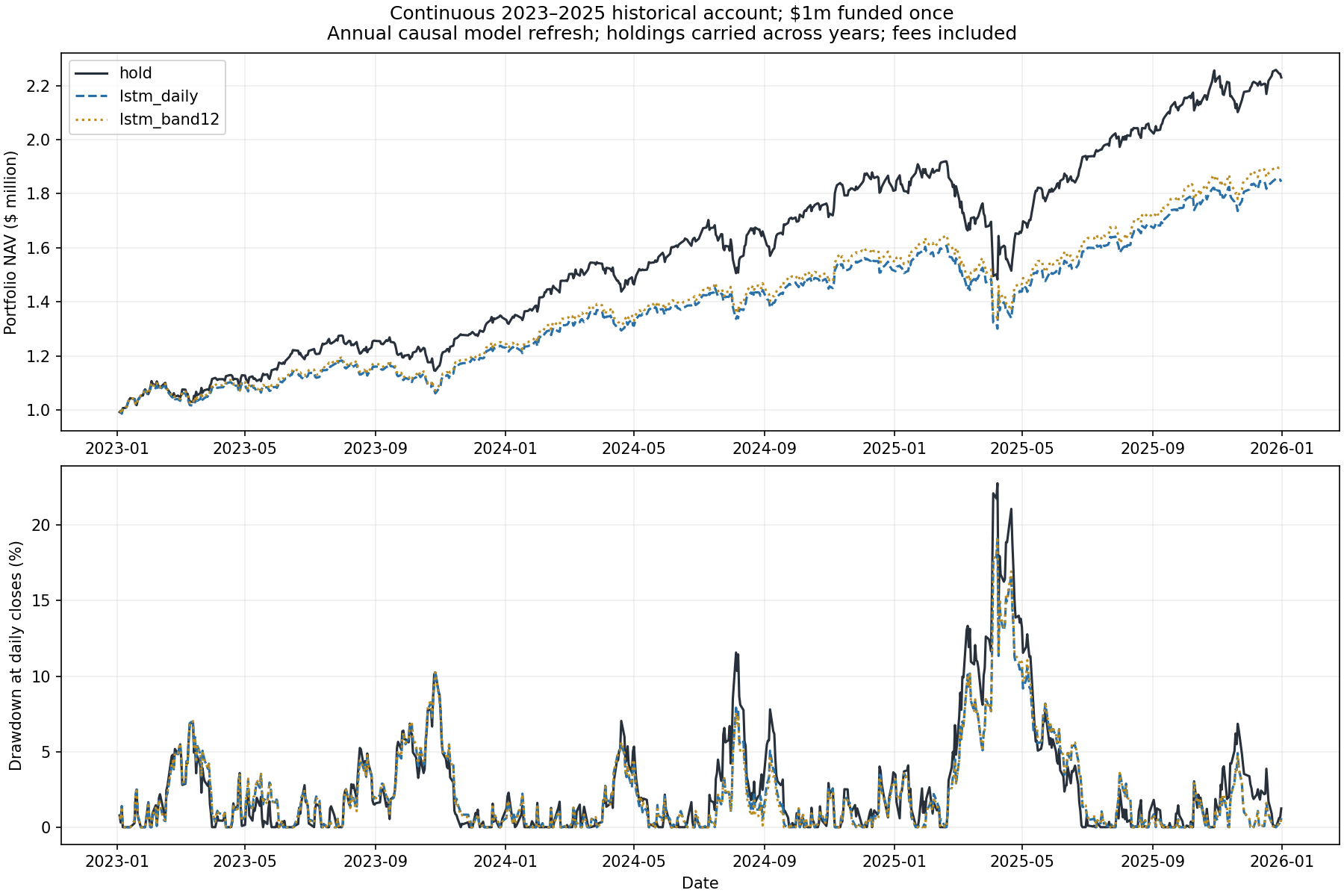
The latest experiment carries capital and shares from January 3, 2023 to December 31, 2025 without annual cash resets. Models refresh annually using earlier labels. All accounts start with $1m, include fees, and retain final positions at their endpoint values.
| Policy | Ending NAV | Net profit | Maximum drawdown |
|---|---|---|---|
| Buy and hold | $2,229,838 | $1,229,838 | 25.52% |
| Daily enhanced LSTM | $1,844,097 | $844,097 | 20.70% |
| Enhanced LSTM, 12% band | $1,887,358 | $887,358 | 20.75% |
The band saves about $16,431 in actual simulated fees versus daily LSTM over this path. Positive profits do not establish market-beating alpha: hold has the highest total profit here. These are historical proxies, with a fixed surviving stock universe, excluded incomplete sessions and missing dividends, market impact and extra slippage. Earlier inspected years are not independent holdouts or forecasts of future returns. Competition ranking is unverified.
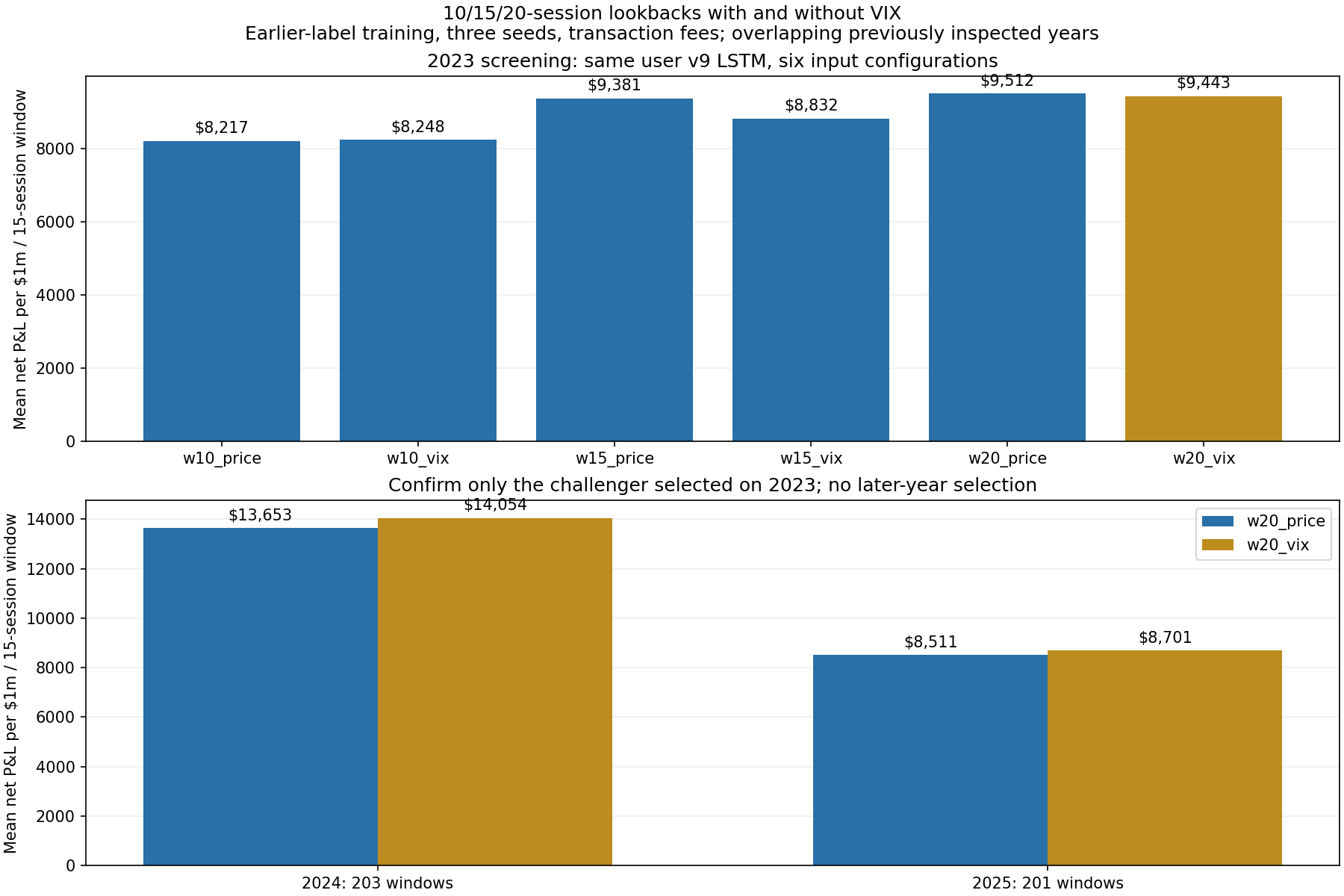
The accompanying 10/15/20/VIX study screens all six configurations on 2023,
then evaluates only the challenger selected there against the fixed control
in 2024 and 2025. The maximum budget is 21 new fits; failed variants are kept
in the evidence. Its protocol and final qualification are stored separately
in output/lstm-lookback-vix/ in the competition checkout.
Live submission 1481 uses the original enhanced ensemble allocation without the new turnover band. New research does not silently change that sealed entry. The organizer executes it at its scheduled boundary; local research does not have to wait for that boundary.
Completed lookback and VIX experiment: October 9, 2026
All six configurations use the same user v9 architecture, three seeds and fees. Screening uses 206 matched 15-session windows in 2023. Mean net profit per $1m window is $8,217 (10), $8,248 (10 + VIX), $9,381 (15), $8,832 (15 + VIX), $9,512 (20 frozen control) and $9,443 (20 + VIX).
The best new challenger, 20 + VIX, is tested in 2024 and 2025 even though it is below the control in 2023. Its mean profits are $14,054 versus $13,653 in 2024 (203 windows), and $8,701 versus $8,511 in 2025 (201 windows). It is not promoted: the 2023 profit gate fails, and the 2025 fifth percentile worsens by 0.2313 percentage points beyond the allowed 0.2. These windows overlap and are previously inspected; their profits cannot be added together as a continuous account’s earnings.
Fees are already included in every reported profit. The continuous band account paid $52,474.72 in fees, versus $68,905.79 for daily LSTM.
A sanitized, reproducible result and lineage snapshot is published in
docs/evidence/icaif-2026-10-09.json. Model weights, source market data and
private competition credentials remain outside Git.